



Main Article: Raising Open-Handed Kids
Hot Quote: Uche Anizor
From the News: Students, Fear of AI, & Critical Thinking Skills
Trends: Aura Farming
Latest Research: Sugar-Sweetened Beverages
Quick Stats
Top Ten: Coolest Food Brands Among Teens
Helpful Insight: Your Kids and the Community of Faith
From the Word
Podcast
Resources
Download the PDF
“When it comes to integrating Christian faith into the material and financial parts of their lives, even Christian kids – like the rest of us – are having difficulty.”

There is something troubling I experienced over four decades ago that I just haven’t been able to shake. I was a very young and very green youth pastor who had just arrived in town a couple of weeks prior. I had the opportunity to go boating with a group of six high schoolers I hardly knew in the clear blue waters off the coast of Miami. We enjoyed the beautiful weather while swimming and water-skiing off the back end of a pretty impressive boat that belonged to Dave’s father. When it was Dave’s turn to ski, I went to the back of the boat to slide him the skis while he dove into the water. When he came up out of the water, he leaned back and let out a comfortable sigh. “Ahhhh,” he mockingly said. “I wonder what the poor people are doing today.”
In that moment, I was left stunned and speechless. I found Dave’s attitudes and words incredibly troubling. But it also troubled me even more that as a leader who should have known how to respond in the moment, I found myself disturbed, but unsure of what to say.
Time has allowed me to think more deeply about what happened that day. In hindsight, I realize that in that moment, Dave had gotten one thing absolutely right, and one thing horribly wrong.
What Dave got right was the reality of where each of us on that boat stood in the world order of wealth. . . and it’s reasonably certain that each of us reading these words stands in that same spot today. You see, if the world’s population was lined up from richest to poorest, all of us would be standing at or very close to the front two percent of the line. Even though we might think it not so, we are rich! In a roundabout manner, Dave was clearly celebrating the wealth that was in that boat.
What Dave got wrong was his perspective on what it means to be rich. We have become so consumed with meeting our own needs that we forget about or don’t even care for those less fortunate than ourselves. Our actions, particularly our lack of stewardship of God’s gifts to us, along with our lack of generosity to others, reveals the fact that we are satisfied with being self-centered. We’ve also failed to reckon with the very real trap of gaining the whole world, while forfeiting our soul (Mark 8:36).
When it comes to integrating Christian faith into the material and financial parts of their lives, even Christian kids – like the rest of us – are having difficulty. I’ll never forget something Kenneth Kantzer wrote that hit me right between the eyes with a proper perspective: “The most serious problem facing the church today is materialism – materialism not as a philosophical theory, but as a way of life.”1
More and more of today’s teens, even many (most likely most) who profess faith in Christ, see nothing wrong with pursuing a lifestyle of self-focused accumulation, and they do this in spite of the fact that Jesus called his followers to be totally committed to him, as opposed to being preoccupied with their own material needs. As one who speaks from experience, I can tell you that the more I have, the more those things that I have cloud or block my view of Christ and his calling. It’s a never-ending battle.
Perhaps we shouldn’t be surprised by the selfish reflection we see of ourselves in the mirror of today’s youth culture. Our kids have been exposed to the disease of self-centeredness. And like those of us who are adults, our kids run the risk of living with the disease so long that they don’t even realize they have it.
But we can’t stop at being surprised. Jesus has called us to “follow” him by prioritizing obedience to his will and his way at the top of our earthly pursuits. The best way to lead our children and teens into a life of faithful obedience is to pursue faithful obedience ourselves. Leading and guiding your own kids begins with looking into the mirror and staring at your own heart. As Jesus said, “For where your treasure is, there your heart will be also” (Matthew 6:21). So, where is your heart?
Along with modeling faithful obedience that puts earthly things in their proper place, we must preach the same Gospel to the hearts of our kids. In addition, we must adjust our spending and living habits to more clearly reflect Kingdom priorities, investing our overflow of time and money in ways that help others. Instead of arrogantly wondering or even ignoring what the poor people are doing today, humbly minister to those in need. . . with deep gratitude to God for what you’ve been given.
Let’s pray that our kids will break the patterns we’ve set and live to embrace the calling of Christ, rather than the false gods of wealth, comfort, security, control, and worldly success. And, let’s do all we can to make that happen.
1 Kenneth S. Kantzer, “Ron Sider Is Mostly Right,” Christianity Today, 8 October 1990, 21.


“The way that we grow in our love for Scripture is not by being distant and hoping that God will beam down love for Scripture from heaven. Rather, we have to actually give it some serious attention and be honest with ourselves about whether or not we are actually doing that. On top of that, we need to pray earnestly… When we approach God’s word, we need to recognize that if it’s personal communication, if it’s for our good, and if God wants to feed us, then we need to pray that God would do that every time we engage with it.”

Uche Anizor
Uche Anizor, author of The Goodness of God in the Gift of Scripture: 20 Meditations, in a video/article titled “How to Choose God’s Word over Everything Else Begging for Our Attention,” crossway.org, March 17, 2026.

STUDENTS, FEAR of AI, & CRITICAL THINKING SKILLS
Artificial Intelligence, or AI, is all the buzz right now. It’s come on the scene quickly, and so many are enamored with what it can do.
For those of us who have engaged with AI through the growing number of apps that are out there, we are generating songs, videos, images, and even text in literally a split second, and what we see is so amazing that it can draw us in just as quickly as it responds to our prompts. Dartmouth University professor Scott Anthony has been watching his students to discern what they’re feeling about a future saturated with AI. In an article in Fortune Magazine, titled “‘They’ll lose their humanity’: Dartmouth professor says he’s surprised just how scared his Gen Z students are of AI”, Anthony says he’s noticing that his students fear losing their critical thinking skills to the AI Machine. The late media philosopher Marshall McLuhan saw this coming. He said this, “We shape our tools and then our tools shape us.” Parents, exercise caution in how you embrace AI in your life and home.

TRENDS:
Aura Farming
It’s spring and the farmers are out in force prepping their fields and planting seeds with the hope and anticipation of a bountiful harvest. There’s a new trend among our kids that’s all about farming, but not in the way our professional farmers are now farming. No, our kids are involved in what’s called “aura farming.” In the teenage world, someone who has aura is someone who has the same kind of glowing presence as the top social media influencers, beloved celebrities, and people who ooze coolness. Aura Farming is the term used to describe the act of doing things online to boost your cool factor in the eyes of the world that’s watching you on social media. In essence, you’re farming and fishing for the social capital of likes, positive comments, and a growing number of followers. Parents, this is a troubling trend as our kids are going to look for love and attention in all the wrong places. Lead them to find their identity, purpose, and value in Jesus Christ and not in the eyes of others.

LATEST RESEARCH:
Sugar-Sweetened Beverages
The beverage coolers in one of our local quickmarts take up almost two entire walls. There’s everything in there from a variety of water products, to carbonated soft-drinks, to energy drinks. Many of the beverage products in those coolers are what would be known as SSB’s, or sugar-sweetened beverages. It’s no secret that our children and teens largely favor these SSB’s, as they are packaged and marketed in ways that attract their attention, along with the fact that kids have always loved the taste. A new study reported in the Journal of Human Nutrition and Dietetics reminds us that these drinks and other sugary foods do contribute to childhood obesity and type 2 diabetes. But the study also found that there’s a connection between high sugary drink intake and increased anxiety in teenagers. Parents, you are called to keep watch over and steward your child’s physical and mental health. Control your child’s intake of sodas, energy drinks, and sweetened juices.

Nearly 1 in 5 users aged 13 to 15 told Meta that they saw “nudity or sexual images on Instagram” that they didn’t want to view.
(A 2021 Meta Users Survey made public through a recent court filing)
Self-injury has been reported in approximately 10% of youth. A systematic review showed a significant and consistent increase of about 3.5% annually since 2000.
(JAMA Network Open)

Coolest Food Brands Among Teens
Among 13-16 year-olds
Source:
YPulse
Teen Cool Brands 2026 Report
1. Doritos
2. Flamin’ Hot Cheetos
3. Chick-fil-A
4. Oreo
5. McDonald’s
6. Coca-Cola
7. Cheetos
8. Sour Patch
9. Takis
10. Gatorade


YOUR KIDS AND THE COMMUNITY OF FAITH
by WALT MUELLER
Parents, today I want to encourage you to have your family attend a church where the adults, teenagers, and children all worship together rather than going their separate ways when they walk into the building. By doing this, they will be afforded the opportunity to see the faith modeled by other adults. Writer Steve Garber knows the valuable role the inter-generational Christian community plays in the spiritual awakening, growth, and nurture of kids.
He writes:
“For individuals to flourish they need to be part of a community of character. Community is the context for the growth of convictions and character. What we believe about life and the world become plausible as we see it lived out all around us.”
Parents, your kids need to experience the full breadth and depth of the larger body of Christ. God will use your church and wide diversity of members, young and old alike, to celebrate and affirm all that you are teaching them as you nurture them in the home.

“Do not lay up for yourselves treasures on earth, where moth and rust destroy and where thieves break in and steal, but lay up for yourselves treasures in heaven, where neither moth nor rust destroys and where thieves do not break in and steal. For where your treasure is, there your heart will be also.”
Matthew 6:19-21
God cares deeply about our attitudes toward money and wealth. Did you know that more is said in the New Testament about money and wealth than about heaven and hell combined? Five times more is said about money than about prayer. And 16 of Christ’s 38 parables deal with money.
In the Sermon on the Mount, Jesus speaks to his followers about the lasting value of two types of treasures (Matthew 6:19-21). All too often we focus on the first type of treasure. He knows the broken and sinful bent of the human heart. He knows that we have strong desires and that those desires can be horribly misdirected as evidenced by our yearning after the accumulation of money, wealth, and material goods. These are what he calls the “treasures on earth.” He does not forbid the accumulation of possessions, private property, and savings. Rather, he is forbidding the selfish accumulation of temporary things that tether our hearts to this world. These “treasures on earth” are subject to the decomposition of moth and rust, and they are not something we can take with us.
The treasures we are to seek and put our focus upon are what he calls the “treasures in heaven,” which are treasures that are incorruptible and eternal. But since we all still have some measure of earthly possessions while we are alive on this earth, Jesus calls us to steward and use our money and wealth for the advance of the Gospel. John Stott says that “Jesus seems to be saying to us, ‘If it’s a safe investment you’re after, nothing could be safer than this; it’s the only gilt-edge security whose gilt will never tarnish.’”



Youth Culture Matters is a long-format podcast from CPYU hosted by Walt Mueller.
BE SURE TO CHECK OUT EPISODE 216:
“Inviting Teens and Young Adults into Biblical Truth” with Rut Etheridge

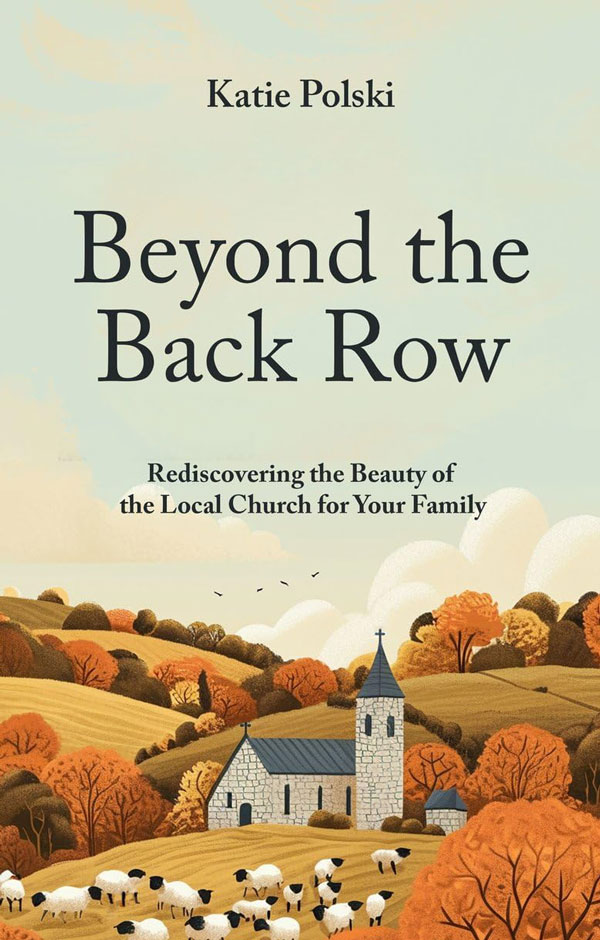
A heartfelt and practical guide that will inspire readers to rediscover the beauty and importance of active involvement in their local church.
Beyond the Back Row: Rediscovering the Beauty of the Local Church for Your Family by Katie Polski is a timely and inspiring call to renew our love and commitment to the local church. In an era where church attendance is declining and many find themselves disconnected from religious communities, Polski offers a compelling vision for why the church matters and how it can transform our lives and the lives of our families.
Drawing on her experiences as a pastor’s wife, mother, and active church member, Polski addresses the growing trend of disengagement from church life with empathy and biblical wisdom. She acknowledges the challenges and imperfections of church communities while highlighting the profound beauty and necessity of Christ’s bride.
Throughout Beyond the Back Row, Polski provides practical guidance for cultivating a love for God’s people in both children and teens, recognizing the vital role the church plays in spiritual formation across generations. She offers insights on how to make church a priority in family life and how to navigate the unique challenges of teenage engagement with church activities.

© 2026 All rights reserved. The CPYU Parent Page is published monthly by the Center for Parent/Youth Understanding, a nonprofit organization committed to building strong families by serving to bridge the cultural-generational gap between parents and teenagers.